
This was a historic midterms election—a full-throated repudiation of the Trump-GOP
agenda, which has been defined by lawlessness, corruption, xenophobia, racism, and
misogyny. Millions voted to reject skyrocketing costs, tax cuts for billionaires, cuts to
Medicaid, SNAP and healthcare programs, the terrorizing of communities by masked,
armed ICE and CBP agents, and abuse without accountability. What voters want, as
national polling data shows, are higher wages, universal child care, abortion rights and
access, low-cost health care, paid leave, all of which are core priorities for advancing
gender equity. They believe these policies would help them and their families deal with the
high cost of living. Across the board, candidates’ embrace of these issues helped to deliver historic majorities in the House, the Senate, governorships, and statehouses across the country.
The 2026 midterms demonstrate the profound power of an economic message, focused on cost of living and pocketbook issues, combined with a commitment to racial and gender equity. And while Republicans used the same hateful playbook this cycle, attacking trans people and immigrants, voters forcefully rejected this message. Instead, an expanded Democratic base, powered by Black women and Latinas, delivered transformative victories to candidates who embraced gender and racial justice as a key element of their economic message. This is reflected in both national and state races where we saw historic diversity in the candidates who ran and won. We believe that bold, progressive policy proposals—and specifically a commitment to economic, racial, and gender justice –are the key to continuing to animate and mobilize the Democratic base.
In addition to a demand for a more inclusive economy, the midterms were also a forceful rejection of impunity for open lawlessness and abuse, specifically including gender-based violence. Here too, there is a mandate for action.
- Action on affordability requires action on gender equity.
It is impossible to effectively respond to voters’ demands to bring down the cost of living without recognizing that the affordability crisis is a gendered problem. It is women, especially women of color, who face the highest risk of economic insecurity and therefore
are hit hardest by the affordability crisis. Evidence that women experience greater economic hardship than men is clear and well documented:
- Women working full-time, year-round typically make 84 cents for every dollar paid to men, which amounts to $11,620 less per year; (i)
- Women represent 61% of the low-paid workforce; (ii)
- Federal data from the past year have shown women experiencing labor losses at higher rates than men. (iii)
- Women are more likely to experience poverty than men, with higher poverty rates for many women of color, older women, and families with children headed by single women; (iv)
- In August 2026, women expressed more worry about the cost of health care
- compared to U.S. adults in general (75% v. 70%); (v)
- According to an October 2026 survey, women express more concern than men on key cost of living indicators, including concern their income isn’t rising enough to keep up with inflation (75% of women v. 71% of all adults); concern over being able to pay for utility bills (66% of women v. 63% of all adults), which is consistent with
- similar findings; (vi)
- Women generally carry about two-thirds of the federal student loan debt and take about two years longer than men to repay student loans; (vii)
- Women represent 57% of non-elderly adults enrolled in Medicaid and will be disproportionately harmed as people continue to lose their coverage as a result of the One Big Beautiful Bill Act (OBBBA). (viii)
Because gender and racial inequality imposes steep economic costs on women in general
and women of color in particular, addressing a ordability requires addressing gender and
racial equity. Any solutions aimed at bringing down the high cost of living must address the disproportionate share of the burden borne by women and their families. By the same
token, some of the most e ective policies to address a ordability are those that would
advance gender justice: higher wages, access to a ordable child care, low-cost
healthcare, paid family and medical leave, and access to reproductive health care are
immensely popular and essential for economic security.
- Voters overwhelmingly support policies that address the cost crisis and advance gender equity
For months leading up to the midterms, national polling showed that as Americans
expressed concern over the high cost of living, they consistently expressed support for
many of the policies that they believed would improve their economic security, such as
access to low-cost healthcare (including reproductive health care), access to quality
a ordable child care, paid family and medical leave, and higher wages.
In fresh polling from National Women’s Law Center (NWLC) conducted between Oct. 29-
Nov. 4, 2026, 76% of voters said raising the minimum wage and increasing incomes was an important factor in their voting decision, including 82% of women; 69% said that paid
family and medical leave was an important factor for their voting decision, including 75% of women; 66% said that abortion rights and access was important for their voting decision, including 71% of women; and 66% said a ordable child care was important for their voting decision, including 70% of women.
This is consistent with quarterly polling from NWLC over the last year:
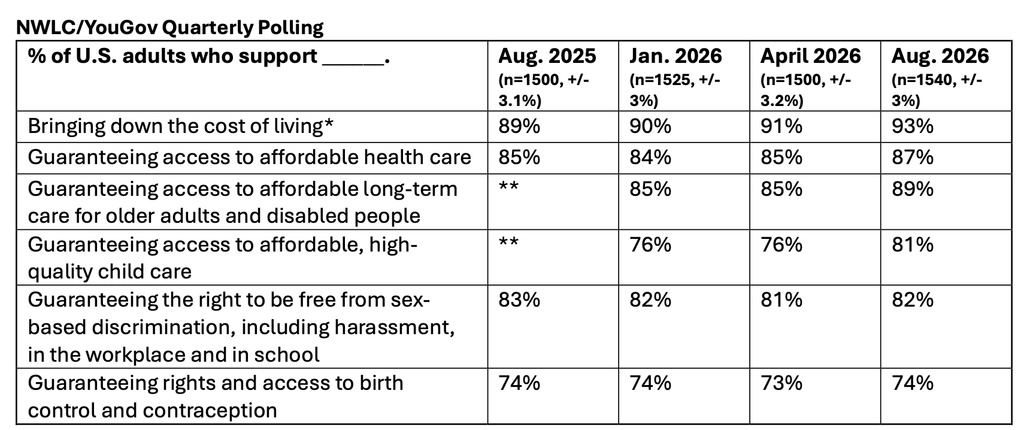
*In August 2025 and January 2026, the question was “passing policies to bring down inflation and the cost of living”.
** In August 2025, 85% of respondents support “guaranteeing access to a ordable, high-quality child care and long-term
care for older adults and disabled people”.
*** This question was not asked to respondents in the August 2025 and January 2026 wave.
Additional information about our August 2025, January 2026, April 2026, and August 2026 can be found here.
In other words, the same voters who have been demanding help with cost of living—and
who delivered majorities in the U.S. House and Senate and many statehouses—support
gender justice policies, which they believe would help mitigate the a ordability crisis.
- There is Democratic consensus around key gender equity policies—and voters want action.
A review of the proactive messaging, ads, and public platforms of the Democrats running at the federal and state levels this cycle demonstrates almost universal support for abortion rights, investments in child care, repealing the Medicaid and SNAP cuts from OBBBA, higher wages, and paid family and medical leave. These are the issues that Democrats ran on and won. Conversely, Republican candidates consistently ran away from them—proof that they understand they are on the wrong side of these issues with voters. Democrats should lean into this consensus to demonstrate results.
A commitment to abortion rights is a baseline requirement for Democratic voters. Democratic candidates in House and Senate races consistently supported abortion rights,
and Democratic candidates who leaned into their support for abortion rights reaped the
benefits. For example, in Kansas, which went 57% to Trump in 2024, Adam Hamilton—an
ordained minister—won after a campaign in which he publicly supported abortion rights
and demonstrated that faith and abortion rights can go hand-in-hand. Voters in Maine
voted out Susan Collins after Troy Jackson made her votes to confirm Supreme Court
justices who overturned Roe v. Wade, including her deciding vote to confirm Justice
Kavanaugh, a centerpiece of his campaign. Abdul El-Sayed’s commitment to abortion
became a major factor in his race against Mike Rogers, whose own long record of opposing abortion rights became a liability for him with Michigan voters. Voters in Missouri, Nevada, and Virginia supported ballot initiatives to uphold or expand abortion rights and access. Republicans, on the other hand, dodged the issue or tried to run away from their anti-abortion views, including by scrubbing their websites and backtracking on their stance on their state’s abortion laws, while Republicans such as Ken Paxton, whose brand is deeply bound up with anti-abortion zealotry, were soundly defeated.
OBBBA remains deeply unpopular and voters want it repealed and benefits expanded.
Across the country, Democratic candidates hammered Republicans for voting for massive
tax cuts for billionaires while cutting Medicaid and SNAP benefits for millions of Americans and allowing ACA enhanced tax credits to expire. Voters weren’t fooled by Republican efforts to rebrand it as the “Working Families Tax Cuts Act.” Additionally, Democrats campaigned on expanding programs including Medicaid, Medicare, SNAP, the ACA, the child tax credit, Head Start, and paid family and medical leave—and ensuring that
billionaires and big corporations pay their fair share in taxes. They now have a mandate and a responsibility to act.
Expanding child care is a leading policy remedy for the affordability crisis. With child care
costs increasingly straining families’ budgets and with hundreds of thousands of children
across the country on child care waiting lists, Democratic candidates for federal and state
o ice broadly embraced plans to expand access to quality child care and make child care
more a ordable—and this helped propel them to victory. Senate Democratic candidate, as
well as many Democrats in battleground House races, consistently named child care as a
priority. There is strong public support for bold, transformative child care solutions, even in
deep red parts of the country, and Democrats need to deliver.
- The hateful, anti-trans Republican playbook fell flat.
Republicans tried using the same strategy of demonizing transgender people and
fearmongering around trans athletes and trans-related healthcare that they used in 2024.
All told, Republicans candidates and SuperPACs spent nearly $400 million on trans-related
attack ads this cycle, only to see the strategy fail. This was true in both Senate and House
battleground races, where Republican candidates doubled down on their anti-trans
attacks. Anti-trans spending was particularly driven by large contributions from Elon Musk
and was most clearly on display in Texas, which responded with a historic blue wave
statewide.
Not only did this strategy fall flat with voters, but the data shows that as a result of this all-in push Republicans have lost ground to Democrats on trans issues. An October 2026 poll
by The Economist/YouGov found that Democrats now hold a 29-point trust advantage on
transgender rights (52% v. 23%) among registered voters. Voters are increasingly fatigued
by the hateful attacks, with an October 2026 Data for Progress poll in Alaska finding that
70% of voters—including 58% of Republicans—wanted to hear less about trans athletes.
Republican o icials are already admitting that anti-trans attacks were not persuasive
appeals to voters, including Florida Gov. Ron DeSantis and former Texas House Speaker
Dade Phelan. In fact, in a Pew survey in October 2026, Democrats were more likely than
Republicans to prioritize LGBTQ+ issues when voting (35% v. 14%), showing that pro-
equality candidates can mobilize supporters by pushing back against hateful attacks.
This cycle, Democratic candidates successfully countered the anti-trans playbook
because they responded with nearly $80 million in response ads, instead of dodging or
leaving harmful messaging unaddressed. Democratic candidates deployed effective
tactics to neutralize the attacks, including by:
- Leaning in on personal biography and values-based messaging, such as in MT-01 and MO-02 (centering personal freedom), KS-Sen and IA-02 (faith-based values), NC-05 and AZ-06 (experience as a parent), FL-22 (experience as an educator), and IA-01 (personal experience with sports).
- Tapping into broader voter enthusiasm for “fighter” candidates that would defend and safeguard rights or stand up to bullies, especially in MI-Sen, MN-Sen, and TN-04.
- Redirecting the conversation by pointing out Republicans’ disproportionate focus and spending on anti-trans messaging, including in GA-Sen (shifting to corruption), TX-Sen (shifting to billionaire spending), and OH-Sen (shifting to Epstein).
As Republican attacks on trans equality continue into the new Congress and future
elections, voters are increasingly evaluating responses to this hateful messaging as an
indicator of a candidate’s character, values, and commitment to civil and human rights.
- The midterms demonstrated a voter hunger for accountability for sexual violence and abuse.
Disgust for the abuse and lawlessness that has been a hallmark of the administration drove landslide Democratic victories. With 61% of women voters choosing the Democratic U.S. House candidate this cycle, part of the repudiation of the Trump administration is a
rejection of the normalization of sexual violence, misogyny, bullying, and sexism without
consequence that has been a defining feature of Trump and of his administration. We saw
this reflected in high-profile races where voters directly weighed in on whether to support
or remove candidates facing allegations of sexual violence or misconduct.
It is also important to note that in the days and weeks immediately before the midterms,
there were several high-profile cases of sexual violence that gained national attention and
became inescapably part of the national discourse as Americans were voting:
Sexual assault on college campuses. In early October, much of the country was consumed
with the Cornell 7 case where Jane Doe came forward with allegations she had been
sexually assaulted by several men at a fraternity. Similar incidents drew national attention
at Louisiana State University (LSU), University of Chicago, University of Arizona, and Loyola University. And the Trump administration responded by rescinding Title IX rules protecting against sexual assault while Donald Trump expressed concern as to whether the alleged Cornell assailants would be treated fairly.
Sexist, controversial ads. Several political ads issued just days before the election targeting
women candidates received national attention and outrage. Vivek Ramaswamy featured
Donna Arthur, Amy Acton’s mother, who accused Amy Acton of lying about being sexually
abused as a child. An ad paid for by Scott Perry in Pennsylvania alleged that his challenger, Janelle Stelsen, exposed herself to a neighbor’s child, and used fabricated images of legal documents to mislead viewers. Voters rejected these gambits.
Accountability over Epstein. Democrats spent tens of millions of dollars in key Senate
races hitting Republicans and Trump on the Epstein files, making it one of the final
messages that voters received in many parts of the country. Relatedly, on Oct. 26, 2026,
just eight days before the midterms, House Judiciary Democrats issued a new report not
only tying Donald Trump more closely to Jeffrey Epstein but also containing new allegations of sexual assault against him.
Gender-based violence, abuse, and misconduct were a major issue in multiple high-profile
races in the midterms and the run up to the midterms, including Eric Swalwell (D-CA), Max
Miller (R-OH), Graham Platner (D-ME), Jimmy Gomez (D-CA), Cory Mills (R-FL), and others.
Each lost their races or dropped out as a result. According to an analysis by the National
Women’s Defense League, 20 candidates facing abuse allegations lost their elections or
left their races.
Taken together, all of this shows that accountability for gender-based violence is part of the accountability that voters are demanding. This also tracks with recent polling from NWLC where 79% of respondents said they favor funding programs to support survivors of
domestic violence and sexual assault. Democrats should answer the call.
i National Women’s Law Center, “NWLC Resources on Poverty, Income, and Health Insurance in 2025,” (September 17, 2026), https://nwlc.org/resource/nwlc-resources-on-poverty-income-and-health-insurance/. NWLC annual loss calculations using U.S. Census Bureau Table “PINC-05. Work Experience- People 15 Years
Old and Over, by Total Money Earnings, Age, Race, Hispanic Origin, and Sex,” for males and females aged 15 and over who are full-time, year-round workers available at https://www.census.gov/data/tables/time-
series/demo/income-poverty/cps-pinc/pinc-05.html. Men’s median earnings are $72,380, and women’s median earnings are $60,760.
ii Sarah Javaid, “Hard Work Is Not Enough: Women in Low-Paid Jobs” (National Women’s Law Center, June 16, 2026), https://nwlc.org/resource/hard-work-is-not-enough-women-in-low-paid-jobs/.
iii https://nwlc.org/press-release/october-jobs-report-women-continue-to-lose-ground-in-labor-market-despite-recent-gain/
iv See National Women’s Law Center, “NWLC Resources on Poverty, Income, and Health Insurance in 2025.”
v National Women’s Law Center, “New Polling Finds Americans Struggling to A ord Basic Needs While Trump Administration Agenda Remains Unpopular,” (September 16, 2026), https://nwlc.org/press-release/new-polling-finds-americans-struggling-to-a ord-basic-needs-while-trump-administration-agenda-remains-unpopular/.
vi Juliana Menasce Horowitz, “Many Americans Are Struggling to A ord Basic Necessities” (Pew Research Center, October 14, 2026), https://www.pewresearch.org/short-reads/2026/10/14/many-americans-are-struggling-to-a ord-basic-necessities/#additional-charts.
vii American Association of University Women, “Deeper In Debt 2021 Update,” (May 2021),
https://www.aauw.org/resources/research/deeper-in-debt/.
viii Robin Rudowitz, Jennifer Tolbert, Alice Burns, Elizabeth Hinton, Priya Chidambaram, and Anna Mudumala,
“Medicaid 101,” (KFF, October 8, 2025), https://www.k .org/health-policy-101-medicaid/.